
⚡ THE ESSENTIALS IN 20 SECONDS
- Share of search is how much of page 1 you own for a keyword, counting organic and sponsored results.
- Profitero tracks page 1 placement, who bids on your brand keywords and trending keywords.
- The data tells you where to invest: defend, attack or stop paying.
- Measure it on a fixed set of 10 to 30 keywords, every week.
IN THIS ARTICLE
In physical stores, brands fight to sit at eye level on the shelf. On Amazon or Walmart, that fight is for page 1 of search: most shoppers choose among the first results. That is why one of the most useful digital shelf metrics is share of search. In this article I explain how to measure it with Profitero and, above all, what to do with the data.
What share of search is
Share of search: the percentage of first-page positions your brand holds for a keyword, counting organic and sponsored results. It is the digital shelf version of “shelf space”.
It is very close to share of voice. The practical difference: share of voice usually focuses on the paid part (how many ad impressions you win), while share of search looks at the whole page, organic and sponsored. Every tool names it slightly differently, so always ask how it is calculated.
What Profitero measures in search
According to its official site, inside the Digital Shelf module Profitero focuses on “maximizing visibility” with three signals: your page 1 placement, competitors bidding on your brand keywords and trending keywords. Everything is measured daily and by retailer, for your brand and for competitors.
How to read the data
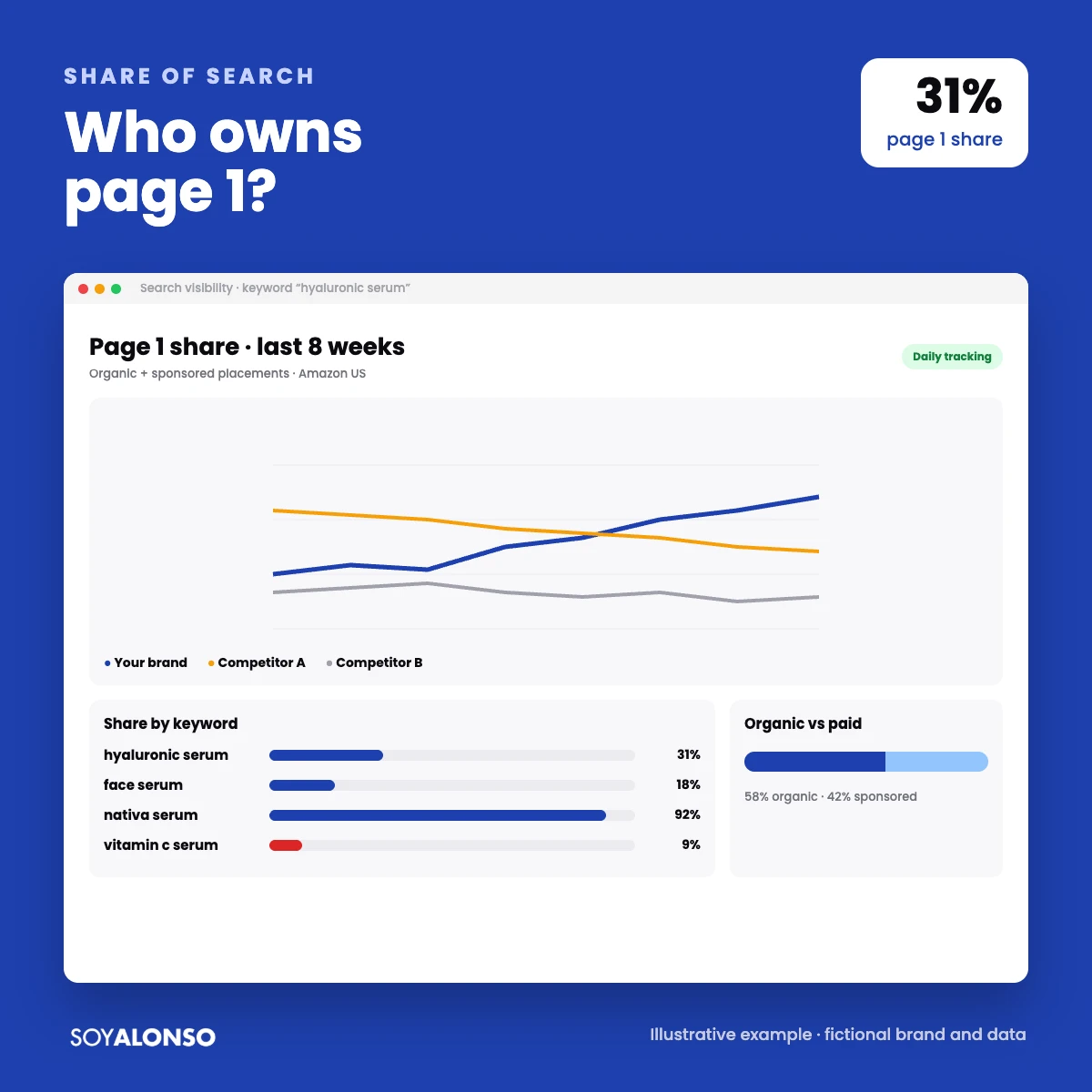
- Split organic from paid. If your total share looks fine but almost all of it is paid, you depend too much on advertising.
- Split brand from generic. On your brand terms you should own almost the whole page; on generic terms the fight is harder.
- Watch the trend, not the day. Positions move a lot day to day. Compare weeks.
- Compare yourself with your direct competitors, not with the whole market.
What to do with the data
| What you see | What to do |
|---|---|
| Your organic share drops on an important keyword | Back it with Sponsored Products while you check content, price and reviews |
| A competitor shows up on your brand keywords | Turn on or increase your brand campaign |
| You rank high organically and also pay a lot for the same keyword | Test lowering the bid: you may be paying for sales you already had |
| A trending keyword where you do not appear | Add it to your listing and test an exact-match campaign |
That last-but-one point is one of the easiest savings: many brands pay to sit on top of keywords they already dominate organically. Controlled bid-reduction tests can free budget for generic keywords where you really need help.
How to build your keyword list
- Pick 10 to 30 keywords, not hundreds: the ones that sell most and the ones that matter strategically.
- Include 2 or 3 brand terms, the main generic terms in your category and 2 or 3 terms from your main competitor.
- Use your search term report and Brand Analytics to choose them.
- Keep the list fixed for at least a quarter so you can compare.
- Review it every week in the same meeting where you review campaigns.
Page 1 share for your fixed keywords.
Did organic drop, did a competitor enter or did a trend rise?
Defend, attack or stop paying where you already dominate.
Every week, with the same list.
Agency secrets about share of search
What I learned measuring this on large accounts:
If your share on your own brand keywords drops, something is wrong: competition, out-of-stock or content. Fix it first.
Winning all of page 1 on a very competitive keyword usually costs more than it is worth. Look for the profitable position.
“We went from 18 to 31 percent of page 1 on our main keyword” lands better than any ROAS.
Share of search was the metric that best helped me explain to clients why to invest in content and not only in ads: when the listing improved, organic rose and dependence on advertising fell.
I’m Alonso Jiménez, a Retail Media account director. I manage campaigns on Amazon, Walmart, Target, Instacart and Mercado Libre every day, for brands in the US, Mexico and Latin America. In the Profitero series I show how to turn every shelf metric into an investment decision. If you are just starting, read what Retail Media is.
Frequently asked questions
What is share of search on Amazon?
The percentage of page 1 positions your brand holds for a keyword, counting organic and sponsored results.
Is it the same as share of voice?
They are similar. Share of voice usually measures the paid part (ad impressions) and share of search the whole page. Each tool defines it slightly differently.
How often should I check it?
Weekly for decisions, with daily alerts for important events such as a competitor bidding on your brand.
How many keywords should I track?
Between 10 and 30 well-chosen ones. More keywords do not mean better decisions.