
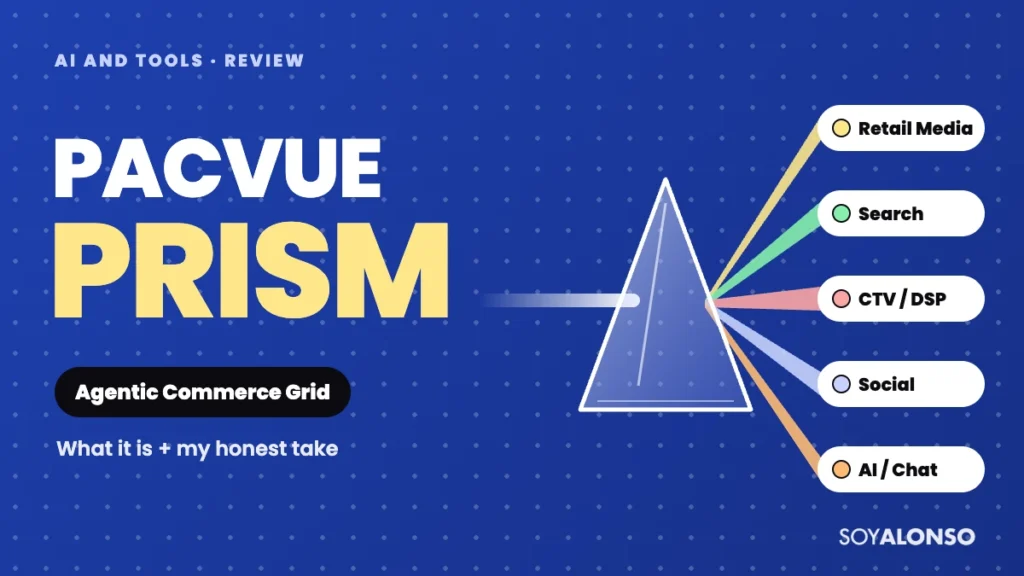
Every year a platform shows up promising to “unify everything.” Most of the time it is the same dashboard with a new name. Pacvue Prism is different in one way: it is not selling a new report, it is selling a new way to manage budget. For those of us who do this for a living, that actually changes the game.
I am Alonso Jiménez, a Retail Media account director managing campaigns across Amazon, Walmart and Mercado Libre every day, for US brands and for Latin American brands entering the US. I use Pacvue day to day, so here is what Pacvue Prism is, how the Agentic Commerce Grid works, what it connects to, the numbers Pacvue is reporting, and my honest take: what I like, what worries me and who it makes sense for.
Official Pacvue video: “Pacvue Prism: Welcome to the Post-Funnel Era”.
⚡ THE ESSENTIALS IN 20 SECONDS
- Pacvue Prism is the platform Pacvue launched in Cannes on June 22, 2026 to run all your media (retail media, search, programmatic, CTV, social and chat) from one place.
- Its core idea is the Agentic Commerce Grid: you stop splitting budget by channel and give the agent one business goal.
- It is built for enterprise brands and agencies. The alpha numbers look good, but Pacvue has not shared how they were measured.
IN THIS ARTICLE
What Pacvue Prism is (and what it is not)
Pacvue Prism: Pacvue’s commerce-native media platform that connects every channel you invest in to your sales outcomes. It lets you plan, run and measure retail media, search, programmatic, social and new formats (conversational and shoppable) with one AI agent and one budget.
Pacvue unveiled it on June 22, 2026 in Cannes. Until then, Pacvue was the tool many of us use to run Amazon, Walmart, Instacart and other retailers: rules, bids, dayparting, reporting. With Prism, the company makes a bigger move: it wants to be where a brand’s entire media budget gets decided, not just retail media.
What it is not: it is not another dashboard stitching reports together, and it is not a chatbot bolted onto the platform. According to Pacvue, it is a single agent that audits the account, builds a plan and executes changes to budgets, bids and creatives across channels. It is also not for everyone: it targets enterprise brands and agencies and is sold through a demo.
This follows a clear path. In April 2026 Pacvue launched Pacvue Agent, its AI agent to recommend and execute optimizations, and it also released an MCP server so its data can be used from other AI tools. Prism brings all of that together and takes it beyond retail media. For the bigger picture, start with what Commerce Media is.
The Agentic Commerce Grid, explained without the fluff
The name sounds like a consulting deck, but the idea is simple. Today most brands run media in silos: one budget for Amazon, another for Google, another for CTV, another for social. Each with its own report, attribution and team. At month end nobody can answer the CMO’s question: what is actually driving sales?
The Grid flips that logic. Your media is organized in a grid with three axes:
- Channel: retail media, search, programmatic, CTV, social, discovery platforms and new formats like chat.
- Ad type: sponsored, display, video, shoppable, conversational.
- Customer journey stage: discover, consider, buy, rebuy.
The key point: Pacvue says the Grid rejects the fixed funnel. No channel is locked to a stage. TikTok can sell and Amazon can drive discovery. That is why the video talks about the “post-funnel era.” And when a new channel appears, the Grid expands instead of arguing about where it fits. Click the buttons to see the difference:
ANIMATION · FROM FUNNEL TO GRID
Five budgets, five reports and nobody knows which channel drove the sale.
My own illustration of the Grid idea. Not the actual Prism interface.
And this is the official animation Pacvue used to introduce Prism. It shows the idea of one system "opening up" across every channel really well:
The real shift is not technology, it is mindset: you stop managing channels and start managing goals. You no longer ask "how much do I give CTV?" You ask "I want to grow new-to-brand sales by X, where should every dollar go this week?"
What Prism does: its 6 pieces
Pick a product and Prism builds the strategy. You review it and launch in one click.
A diagnosis of what is driving performance and where money is being wasted.
One agent audits the account, builds an execution plan and changes budgets, bids and creatives within the guardrails you set.
One budget manager for the whole Grid. You set the goal and Prism allocates spend across channels.
Combines regression modeling with custom attribution and pixels to tie spend to outcomes, even on channels that used to report reach only.
Connects to data lakes, warehouses, CDPs, CRMs and your own AI agents through MCP (Model Context Protocol).
Everything lives in one interface: one login to plan, run and analyze. For an agency team jumping between six consoles today, that alone is an argument.
What Pacvue Prism connects to
| Channel type | What it includes (per Pacvue) |
|---|---|
| Retail media | 100+ retailers and media networks (Pacvue’s core: Amazon, Walmart, Instacart and more) |
| Programmatic / DSP | The Trade Desk; Yahoo DSP was in progress at launch |
| Social and discovery | Pinterest, TikTok, Reddit and other platforms |
| CTV | tvScientific by Pinterest |
| Conversational (AI) | ChatGPT / OpenAI Ads |
| Shoppable and video | Firework and Shopsense AI |
Look at ChatGPT. A retail media platform putting conversational ads in the same budget as Amazon tells you where this is heading. If that channel interests you, here is my complete ChatGPT Ads guide.
The alpha numbers (and why I take them with a grain of salt)
Pacvue says brands testing Prism in alpha saw gains mostly on investments that used to be measured on reach alone, like CTV, social and brand campaigns:
impressions
CPM
total sales
new-to-brand growth
They look good. But Pacvue has not disclosed how many brands took part, which categories, what period or what baseline. A number without methodology is a promise, not a result. I am not saying they are wrong; I am saying ask to see how they were measured on an account like yours before you sign.
My honest take on Pacvue Prism
Where my opinion comes from: I use Pacvue to run retail media, but I have not run Prism on an account of my own. This is my read as someone who manages large budgets and sees the problem Prism is trying to solve every single day.
It attacks the right problem. Brands do not lack reports; they cannot tell which channel drives sales. Prism goes straight at that.
Budget by goal. Moving money across channels in real time instead of waiting for the monthly review is what everyone wants and almost nobody does.
Born from sales data. Pacvue comes from retail media, where the sale sits close to the ad. That is an edge over platforms that come from the brand side.
Early on conversational AI. Having ChatGPT on the same board from day one is a smart bet.
Numbers without methodology. Until I see how they measure incrementality, they are promises.
Alpha and enterprise. Several integrations are new and others were still "in progress" at launch. First versions always have gaps.
The agent black box. An agent moving budget on its own is fine, if you can see why it moved it. Demand that log.
Cross-border. If you sell in the US and Mexico, check in the demo how well Latin American marketplaces are connected. Whatever matters to your business has to be in the Grid.
My verdict: Prism is the right direction for the industry, and I think in two or three years this is how large brands will manage media budgets. Today, if you are an enterprise brand across many channels, the demo is worth your time. If you are a seller still mastering Sponsored Products, do not get distracted: basics first.
Quiz: is Prism for you?
Answer the 5 questions and I will tell you what I would do in your shoes:
QUIZ · IS PRISM FOR YOU?
Prism vs. classic Pacvue: what changes for an agency
| Pacvue (retail media) | Pacvue Prism | |
|---|---|---|
| Scope | Retailers and marketplaces | Retail media + search, programmatic, CTV, social and chat |
| Budget | By retailer and by campaign | One budget, tied to a goal |
| Optimization | Rules, bids and dayparting you configure | An agent that audits, plans and executes within your guardrails |
| Measurement | Each retailer’s attribution | Cross-channel halo measurement |
| Who it is for | Large sellers, brands and agencies | Enterprise brands and agencies |
To get the most out of classic Pacvue in the meantime, here is my complete Pacvue guide for agencies.
Agency secrets for evaluating Pacvue Prism
What I would ask in the demo, learned from years of sitting across the table from tech vendors.
Do not accept a "before vs. after." Compare against part of the budget managed the usual way. It is the only way to see incrementality.
Before you turn it on: how much it can move per day, which channels it cannot touch and which metrics it can never sacrifice. In writing.
Every change the agent makes should come with a reason you can show your client or your boss.
If your CRM or catalog is messy, the agent will optimize on garbage. Clean first, connect second.
An agent executes fast, but someone has to set the goal, read the business context and hit the brakes when something looks off. That is still your job.
The tools that gave me the most value are not the ones that automate the most, but the ones that show me fast where the money is going. If Prism delivers that across channels, it will be a before and after. If it stays a black box, it will be one more expensive dashboard.
Conclusion: the right idea, now it has to prove it
Pacvue Prism is Pacvue’s most ambitious bet: moving from a retail media tool to the operating system for a brand’s entire media, with an AI agent and one budget tied to sales. The idea is right. What is missing is the methodology behind its numbers and how it performs beyond alpha.
To go deeper, read what Retail Media is and in-house vs. managed services. And if you want to check whether your brand is ready for something like this, book a 1:1 consultation. On YouTube: Retail Media con Alonso.
Frequently asked questions
What is Pacvue Prism?
It is the Pacvue platform launched on June 22, 2026 to plan, run and measure media across every channel (retail media, search, programmatic, CTV, social and conversational formats) with one AI agent and one budget tied to commerce outcomes.
What is the Agentic Commerce Grid?
It is how Pacvue organizes your media inside Prism: a grid that crosses channel, ad type and customer journey stage, connected to your sales data. Instead of managing budgets by channel, you set a goal and the agent allocates spend.
How much does Pacvue Prism cost?
Pacvue does not publish pricing. Prism is aimed at enterprise brands and agencies and is sold through a demo.
Does Pacvue Prism replace Pacvue?
No. Prism builds on the retail media capabilities Pacvue already had and adds search, programmatic, social and new formats in one interface.
Is Prism a fit for small Amazon sellers?
Not today. It is built for brands with large budgets across several channels. If you sell on Amazon or Mercado Libre with a small budget, you will get more value from mastering their ad consoles first.
Pacvue: Prism · Pacvue: launch press release (Jun 22, 2026) · PPC Land: launch analysis · YouTube: official Pacvue video