
⚡ THE ESSENTIALS IN 20 SECONDS
- Every time someone searches on Amazon, an auction runs in milliseconds to decide which ads appear and in what order.
- The highest bidder does not automatically win: ad relevance for that search counts too.
- You usually pay less than your max bid: what is needed to beat the next competitor.
- Your bidding strategy and placement adjustments change how hard you compete for each spot.
IN THIS ARTICLE
Many advertisers raise bids without understanding why they win or lose impressions. If you understand how the Amazon Ads auction works, you make better decisions with less money. Here it is, without jargon.
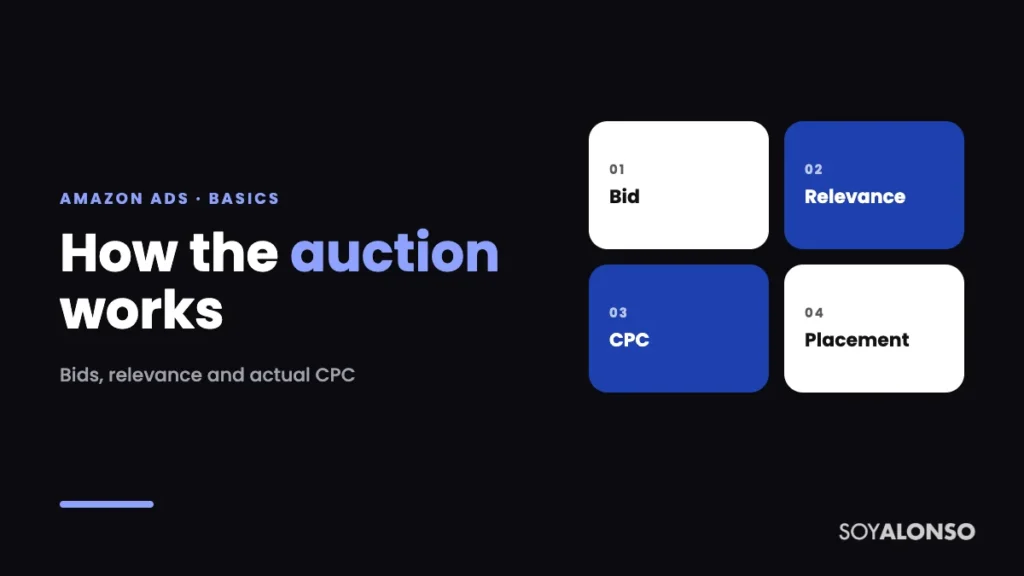
Amazon Ads auction: an automated process that runs on every search or page load to decide which sponsored ads are shown, in which position and at what cost, based on each advertiser’s bid and the relevance of their ad.
What decides who wins
A shopper types a query.
Ads with matching keywords or products enter.
Amazon combines how much you bid with how relevant your ad is.
Spots are assigned and cost per click is calculated.
Relevance depends on how well your product matches the search and on its performance history. That is why a product with strong content, reviews and conversion can win placements with lower bids than a competitor, and why improving your listing is often cheaper than raising bids.
Why you pay less than your bid
Amazon has described its auction as “second-price” style: you usually pay what is needed to beat the next advertiser, not your full max bid. That is why your actual CPC is usually lower than your bid.
| Advertiser (fictional) | Max bid | Result | Approximate CPC |
|---|---|---|---|
| Brand A | USD 1.20 | 1st position | ~USD 0.91 |
| Brand B | USD 0.90 | 2nd position | Depends on the next |
| Brand C | USD 0.60 | 3rd position | Depends on the next |
This is a simplified example: in practice relevance and other factors also affect the final cost.
Bidding strategies
| Strategy | What it does | When to use it |
|---|---|---|
| Dynamic: down only | Lowers the bid when conversion is less likely | Protect ACOS, new accounts |
| Dynamic: up and down | Raises or lowers based on conversion likelihood | Profitable products that convert well |
| Fixed | Always uses your exact bid | Controlled tests |
With “up and down”, Amazon may raise your bid by up to 100% for top of search and up to 50% for other placements, according to its documentation. Check the current values in your account.
Placement adjustments
You can increase your bid by placement: top of search (first page), rest of search and product pages. The adjustment can go up to 900%. It stacks with your bidding strategy, so a high adjustment combined with “up and down” can send your CPC soaring.
What makes you lose the auction
- A low bid compared with competition for that search.
- Low relevance: title, images or category that do not match the search.
- No featured offer (Buy Box): the ad is usually not shown.
- No inventory.
- Budget running out before the end of the day.
How to bid better
- Set your max bid based on your margin (break-even ACOS and maximum CPC).
- Start with “down only” and move to “up and down” on products that already convert well.
- Use placement adjustments based on data, not gut feeling.
- Review the placement report every week.
- Automate bid rules with judgment (see Amazon Ads pacing).
A typical case (fictional)
A supplement brand had “up and down” with a 300% top-of-search adjustment. Its CPC tripled and ACOS soared without sales growing as much. It lowered the adjustment to 50%, kept the dynamic strategy only on hero products and improved content on the rest. Sales held and ACOS returned to healthy levels.
In the auction, relevance is your best discount: a strong listing lets you win with lower bids.
Checklist
- Max bid based on margin.
- Bidding strategy matched to product maturity.
- Placement adjustments reviewed with data.
- Buy Box and inventory secured.
- Listing content optimized for relevance.
- A budget that does not run out before peak sales hours.
- A weekly look at the gap between bids and actual CPC.
Agency secrets about the auction
What I check on every account:
The gap between your bid and your CPC tells you how competitive the search is.
Placement adjustment plus dynamic strategy is the number one cause of unexpected CPCs.
Reviews, images and conversion lower your cost over time more than any bidding trick.
Winning the auction does not mean paying more: it means being the most useful ad for that search at the best possible price.
I’m Alonso Jiménez, a Retail Media account director. I manage campaigns on Amazon, Walmart, Target, Instacart and Mercado Libre every day, for brands in the US, Mexico and Latin America.
Frequently asked questions
How does the Amazon Ads auction work?
On every search, Amazon combines each ad’s bid and relevance to decide positions and costs.
Do I pay my max bid?
Usually not; you pay what is needed to beat the next advertiser.
What is the “up and down” strategy?
A dynamic strategy in which Amazon adjusts your bid based on conversion likelihood.
Why is my ad not showing?
It may be a low bid, low relevance, no Buy Box, no inventory or an exhausted budget.