

⚡ THE ESSENTIALS IN 20 SECONDS
- Your listing content decides whether you show up in search and whether shoppers buy.
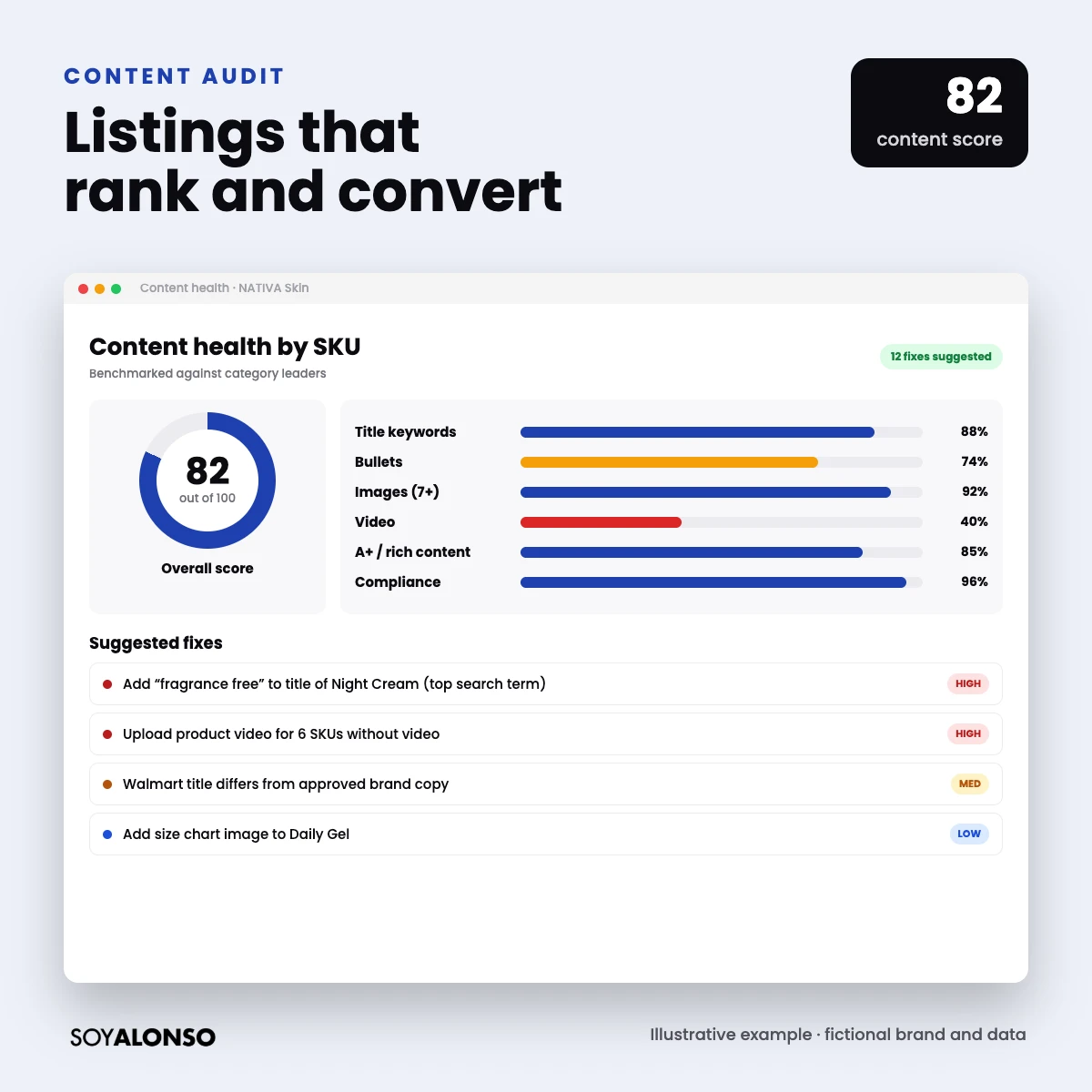
- Profitero Content Optimizer scores listings against category leaders and suggests keywords by retailer.
- It uses generative AI to draft content with SEO, AEO and your brand guidelines.
- An audit only matters if it ends in a prioritized, published list of changes.
IN THIS ARTICLE
You can have the best bidding strategy, but if your listing has a weak title, three photos and no A+ Content, every sale will cost you a lot. In my experience, content is one of the most underrated levers in Retail Media. Here is how to audit it with Profitero and how to turn the audit into results.
Why content is Retail Media too
Content affects two things your campaigns need: relevance (whether the algorithm understands which searches to show your product for) and conversion (whether the shopper clicks “add to cart”). When content improves, the ad performs better with the same bid. That is why at the agency we always review titles, bullets, images and A+ Content before scaling spend.
What Content Optimizer does
According to Profitero’s official site, Content Optimizer is built to create and score your listing content. Its main features are:
- Keyword engine with unique keywords for each retailer (Amazon, Walmart and others).
- Benchmarks: compares your content with category leaders and with each retailer’s standards.
- Generative AI to draft content based on SEO, AEO (answer engine optimization), your priority keywords and your brand guidelines.
- Scores for completeness and discoverability.
- Approval workflow, compliance flags and pushing content to systems such as Salsify.
For Walmart, Profitero also mentions working with the retailer’s Content Quality Score. And if you sell as an Amazon vendor, the Autopilot module automatically fixes content errors, such as titles or images that changed without authorization.
What to check in a content audit
| Element | What to check |
|---|---|
| Title | Main keyword up front, brand, benefit and size. No repetition. |
| Bullets | Benefits first, secondary keywords, objections answered. |
| Images | At least 6 or 7: white background, in use, size, benefits, comparison. |
| Video | A short one showing the product in use. |
| A+ / rich content | Brand story, comparison chart across your products. |
| Consistency | The listing matches (or beats) the brand-approved version at every retailer. |
The process I use
Start with the 10 SKUs that sell most or spend most on ads.
Score and compare against category leaders.
List of changes with owner and date. AI for drafts.
Compare conversion and organic rank 4 weeks before and after.
- Do not audit the whole catalog at once: finish one group and move to the next.
- Every change needs an owner, a date and brand approval.
- Measure before and after on conversion, organic rank and ACOS for those SKUs.
- Repeat the audit every quarter: retailers change requirements and competitors improve.
Care with generative AI
AI saves a lot of time on drafts, but it does not replace judgment. Always check that it does not invent benefits, that it follows category rules (especially in beauty, health and food) and that it sounds like your brand. Treat AI drafts like a junior copywriter’s first version: useful, fast and always reviewed by someone who knows the product and the retailer’s policies.
How to prove the audit worked
Before you change anything, save a snapshot of each priority SKU: content score, conversion rate, organic rank on your top keywords and ACOS. Four weeks after publishing the changes, take the same snapshot. If conversion and organic rank improved while bids stayed the same, you have a clear case to keep investing in content. If nothing moved, review whether the changes actually went live at every retailer, because content syndication delays are more common than most teams expect.
Agency secrets about content
What we see in real audits:
In most audits I run, video is the element with the most gaps and the most impact.
Titles and images change on their own more often than you think. Compliance alerts save you.
Improving a listing’s conversion makes every paid click worth more. It is media optimization without touching bids.
When a client asks me to lower ACOS, the first thing I check is not the campaign: it is the listing. Very often the problem is there.
I’m Alonso Jiménez, a Retail Media account director. I manage campaigns on Amazon, Walmart, Target, Instacart and Mercado Libre every day, for brands in the US, Mexico and Latin America. Want me to review your listings? See my Amazon SEO audit and A+ Content design services.
Frequently asked questions
What is Profitero Content Optimizer?
A Profitero module that scores and improves your listing content with retailer-specific keywords, benchmarks against category leaders and generative AI.
What is AEO?
Answer engine optimization: preparing your content so AI assistants and AI-powered search understand and recommend it.
How often should I audit content?
Every quarter, and always before a big event or before increasing ad spend.
Can I audit without Profitero?
Yes, with a good checklist and by comparing against competitors manually. The tool saves time when you have many SKUs and retailers.