
⚡ THE ESSENTIALS IN 20 SECONDS
- Profitero measures the digital shelf (availability, search, content, price, reviews).
- Pacvue and Skai run and optimize Retail Media campaigns (bids, budgets, rules, reports).
- They are not direct rivals: Profitero even integrates with Pacvue and Skai through its Shelf Intelligent Media module.
- The right question is not “which one?” but “what do I need first: to see the shelf or to run my campaigns better?”
IN THIS ARTICLE
In many meetings with brands I hear the same question: “What is better, Profitero or Pacvue?” It is like asking whether the dashboard or the steering wheel is better. They do different things and, in a mature Retail Media operation, they usually work together. Here I add Profitero to the equation alongside the two most common campaign platforms.
The most common confusion
All three tools show dashboards, metrics and alerts, and all three talk about AI. That is why they look alike in a demo. But their source data is different: Pacvue and Skai work on your campaign data (impressions, clicks, spend, attributed sales); Profitero works on what the shopper sees in the store (whether there is stock, where you rank, how your listing looks, what the price is).
What each one does
| Profitero | Pacvue | Skai | |
|---|---|---|---|
| Main data | Digital shelf | Retail Media campaigns | Retail Media and other channels |
| Typical user | Ecommerce, sales, category | Media team / agency | Media team / agency |
| Typical action | Catch out-of-stocks, improve content, watch prices | Adjust bids, budgets, rules, dayparting | Adjust bids, budgets, rules, reporting |
| Question it answers | How is my product doing in the store? | How do I invest better in ads? | How do I invest better in ads? |
Pacvue and Skai have their own differences (retailer coverage, automation, reporting), but for this article treat them as the “operations layer”.
How they connect
According to Profitero’s official site, its Shelf Intelligent Media module uses shelf signals, such as out-of-stocks or competitor prices, to optimize bids, with variants that work via Skai and via Pacvue, plus a programmatic version with DSPs. In practice the flow looks like this:
Profitero sees a competitor went out of stock or your price went up.
The signal goes to Pacvue or Skai through the integration.
The platform raises, lowers or pauses bids based on the rule.
You see the effect on sales, ACOS and share.
Which stack to choose for your brand
- Small brand (one marketplace, few SKUs): native Amazon Ads or Walmart Connect console plus a manual shelf check. You do not need any of the three yet.
- Mid-size brand (2–3 retailers, steady spend): start with an operations platform (Pacvue or Skai), because that is where the time and budget savings are.
- Large brand (many retailers, countries and SKUs): operations (Pacvue or Skai) plus shelf analytics (Profitero or similar). The value shows up in the connection between the two.
One more tip: whichever stack you choose, write down the three decisions you expect the tools to improve (for example “stop spending on out-of-stock SKUs”, “react faster to price drops”, “report share monthly”). Review them after one quarter. If the tools did not change those decisions, the problem is the process, not the software. And if you are new to the space, start with what Retail Media is.
A practical (fictional) example
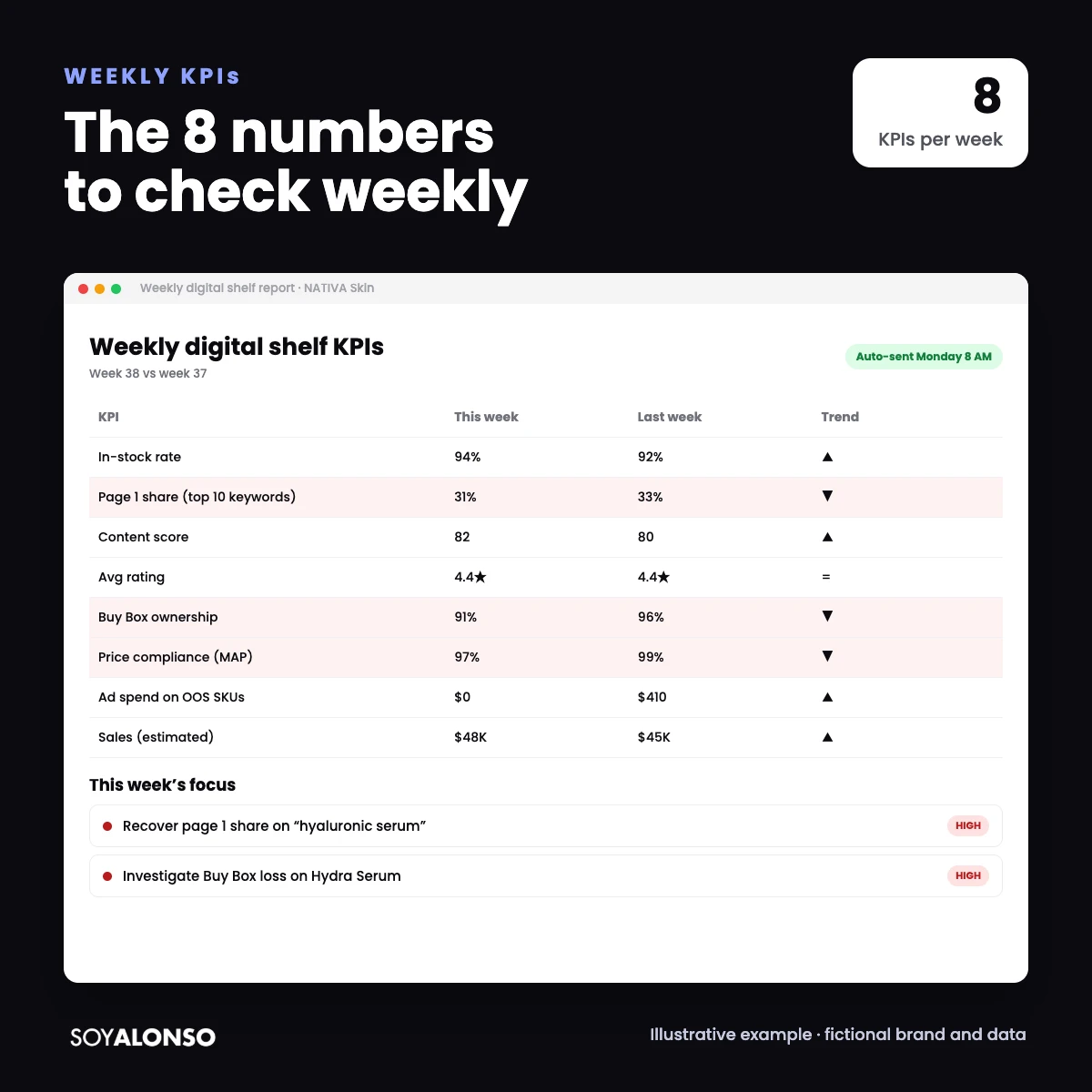
Picture a skincare brand selling on Amazon, Walmart and Target. Its media team uses an operations platform to manage bids and budgets, and every week it sees the ACOS of its hero serum rising on Walmart. The first reaction would be to lower bids. But when they check the shelf, they find three things: the product was out of stock in several stores, a reseller held the Buy Box at a higher price and the listing lost two images after an update.
None of those causes shows up in the ad console. With shelf analytics, the team pauses ads where there is no stock, alerts operations to recover the Buy Box and fixes the content. Two weeks later ACOS is back to normal without touching the bidding strategy. That is the value of joining both layers: operations tell you what is happening to your investment and the shelf tells you why.
- Before lowering bids, check stock, price and content.
- If the problem is on the shelf, fix it on the shelf.
- If the shelf is fine, then optimize the campaign.
Agency secrets about the stack
What I have seen work (and fail):
If today you do not check inventory before touching bids, no integration will do it for you.
When “everyone” owns Profitero, nobody opens it. Assign an owner and a weekly meeting.
Compare a quarter with shelf rules against one without them: protected spend, sales and ACOS.
On the most efficient accounts I have managed, the media team and the ecommerce team look at the same dashboard every Monday. That meeting is worth more than any new feature.
I’m Alonso Jiménez, a Retail Media account director. I manage campaigns on Amazon, Walmart, Target, Instacart and Mercado Libre every day, for brands in the US, Mexico and Latin America. I have worked with several of these platforms on real accounts; here is what I learned without the sales pitch.
Frequently asked questions
Does Profitero replace Pacvue or Skai?
No. Profitero measures the shelf; Pacvue and Skai run campaigns. They complement each other and Profitero integrates with both.
Can I use Profitero without Pacvue or Skai?
Yes. You can use its alerts and take action manually in each retailer’s native console.
Which one should I buy first?
If your priority is investment efficiency, an operations platform. If your problem is out-of-stocks, content or price, a shelf analytics tool.
What is Shelf Intelligent Media?
A Profitero module that uses shelf signals to adjust bids through Pacvue, Skai or DSPs.