
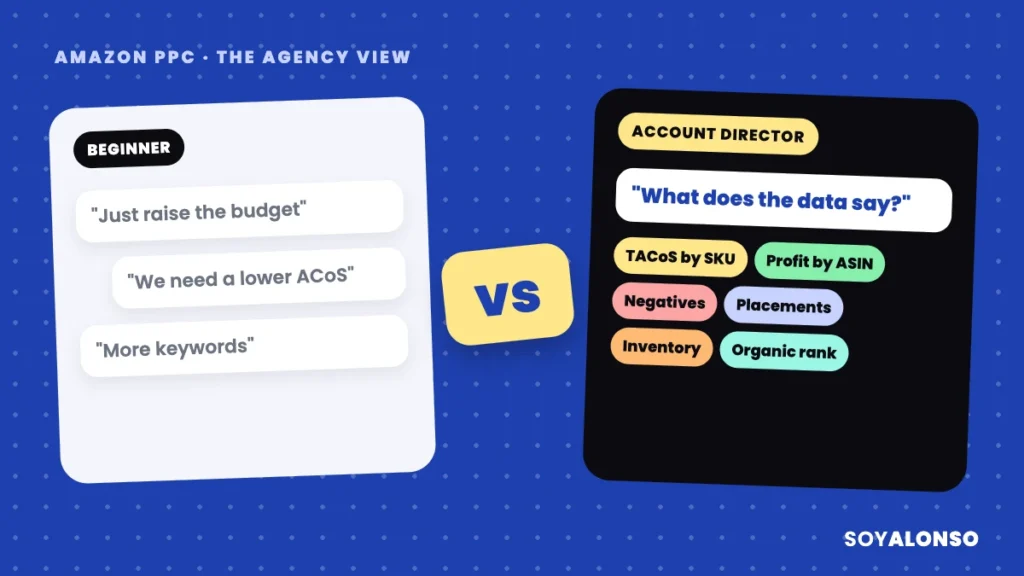
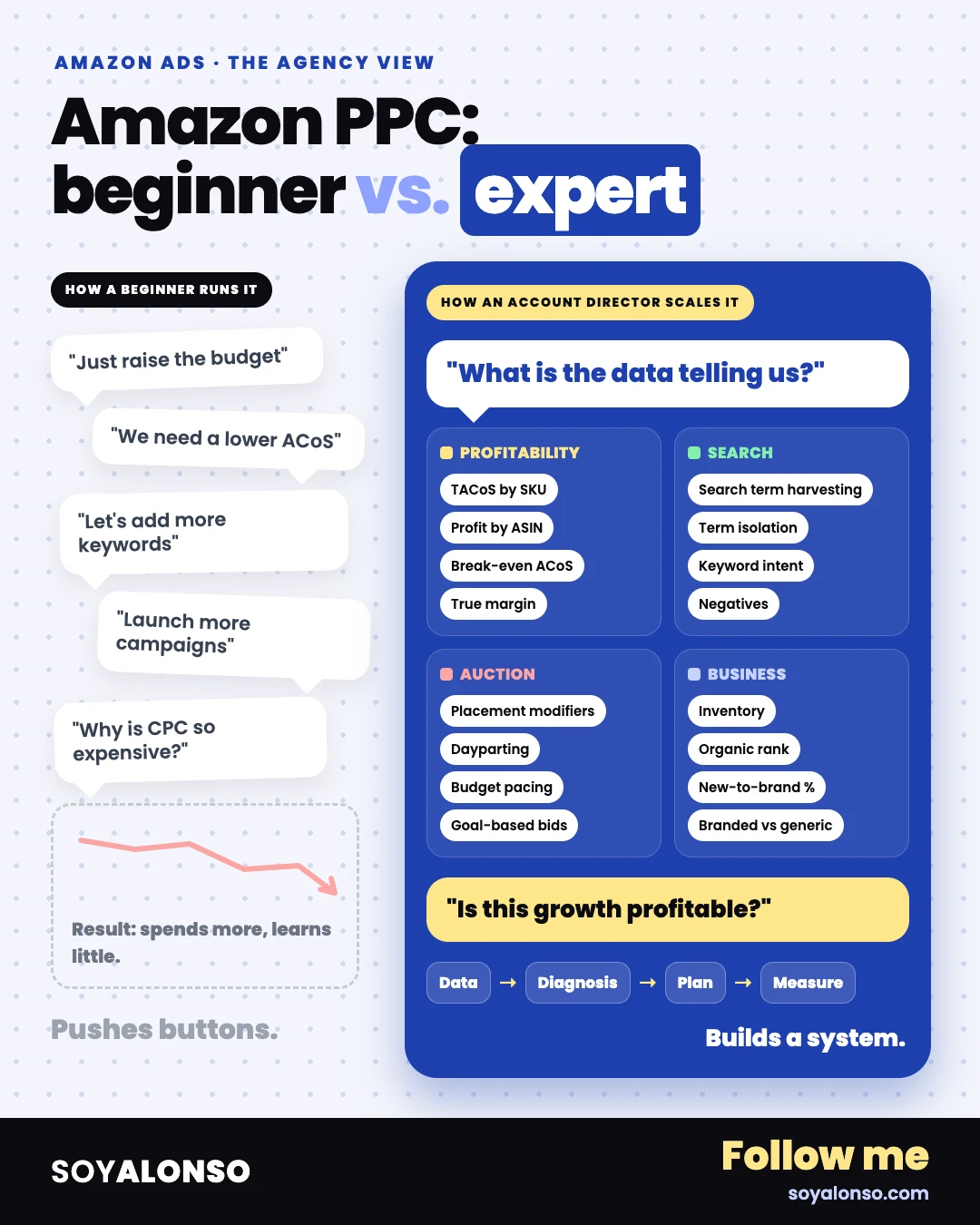
I have spent years in Amazon Ads meetings, and I almost always hear the same five lines: “just raise the budget,” “we need a lower ACoS,” “let’s add more keywords,” “launch more campaigns” and “why is CPC so expensive?” None of them is wrong on its own. The problem is that they are answers without a diagnosis.
I am Alonso Jiménez, a Retail Media account director managing campaigns across Amazon, Walmart and Mercado Libre every day. Here is the real difference between running Amazon PPC and scaling it: the questions I ask instead of those lines, the system I use, a calculator for your break-even ACoS and a quiz to see where you stand.
⚡ THE ESSENTIALS IN 20 SECONDS
- Beginners push buttons (budget, keywords, campaigns). Experts ask what the data says before touching anything.
- Scaling is not spending more: it is growing total sales while protecting TACoS and profit by ASIN.
- The system has 4 layers: profitability, search, auction and business. If one fails, the others will not save you.
IN THIS ARTICLE
What scaling Amazon PPC really means
Scaling Amazon PPC: growing your brand’s total Amazon sales (ad-driven and organic) while keeping or improving profitability. You measure it with TACoS, profit by ASIN and organic growth, not just ACoS.
The difference between a beginner and an expert is not how many console features they know. It is the question they ask before changing anything. Beginners react to a number; experts understand why the number looks that way and which part of the business is moving it.
A low ACoS with flat sales is not success: it is an account that stopped growing. And a high ACoS is not always bad: if you are launching a product or buying organic rank, it can be the best investment of the month. To understand how bids are priced, read how the Amazon Ads auction works.
The 5 beginner phrases (and what I ask instead)
Why it falls short: more budget only helps if the campaigns running out of money are profitable and there is demand you are not covering. Otherwise you just lose money faster.
What I ask instead: Which campaigns run out of budget, at what time and at what ACoS? Do I have the inventory to sell more?
What I do: I check hourly pacing, move money from weak campaigns to profitable ones that cap out, and use dayparting if late-night hours do not convert. More in Amazon Ads pacing.
Why it falls short: forcing ACoS down (by cutting bids) almost always cuts sales and organic rank. You end up with a pretty ACoS and a smaller business.
What I ask instead: What is my break-even ACoS by ASIN? What happened to TACoS and organic sales?
What I do: I split ACoS by objective: branded, generic, competitor and launch. Each one has its own target.
Why it falls short: more keywords without clear intent means more money on searches that do not convert. The account grows in size, not in sales.
What I ask instead: Which search terms are already selling that I do not have in manual yet? Which ones cost me without selling?
What I do: every week I harvest winning search terms from auto and broad campaigns, isolate them in exact match and negate them at the source. If you are still deciding between the two, see auto vs manual campaigns.
Why it falls short: more campaigns without structure means cannibalization. Your own campaigns compete in the auction and the data gets so scattered nobody learns anything.
What I ask instead: Does my structure show me what works by product and objective? Are campaigns fighting over the same term?
What I do: I organize the account by product and objective before opening anything new, and track impression share on the terms that matter.
Why it falls short: a high CPC is not a problem if the click converts. The problem is paying a CPC your conversion rate and margin cannot support.
What I ask instead: What is the max CPC I can pay with my price, conversion rate and target ACoS? Does my listing convert?
What I do: I calculate max CPC (calculator below). If the market pays more than that, I do not raise the bid: I fix the listing, price or reviews to lift conversion.
An Account Director’s system: 4 layers
When I take over a new account, I do not start with bids. I review four layers, in this order:
TACoS by SKU, profit by ASIN, break-even ACoS and true margin after fees and logistics. Without this, every optimization is blind.
Search term harvesting and isolation, intent for each keyword (branded, generic, competitor) and negatives. This is where most money is won or lost.
Placement modifiers (top of search vs product pages), dayparting, budget pacing and bids based on each campaign’s goal.
Inventory, organic rank, new-to-brand share, branded vs generic, price and promotions. Advertising amplifies what the business already has; it does not fix what it lacks.
Ads do not fix a bad listing, a high price or an out-of-stock product: they just make it more expensive. That is why the business layer comes last but weighs as much as the others.
Calculator: break-even ACoS, max CPC and TACoS
Enter your numbers. If your target ACoS is above break-even, every ad-driven sale costs you money (only justified for launches or to win rank).
CALCULATOR · BREAK-EVEN ACOS, MAX CPC AND TACOS
Max CPC = price × conversion rate × target ACoS. Sample values; enter your own.
My weekly routine as an Account Director
| When | What I review | Why |
|---|---|---|
| Monday | Weekend pacing, capped campaigns and stock | Make sure nothing important shut off or is about to run out of inventory |
| Tuesday | Search term report: harvesting and negatives | Where most money is made or wasted |
| Wednesday | Goal-based bids and placements | Adjust on 7–14 days of data, not one bad day |
| Thursday | TACoS and organic sales by ASIN | Know whether ads are growing the business |
| Friday | Client summary: what happened, why and what is next | A report that explains decisions beats a table of metrics |
I build the repetitive work into spreadsheets and rules (see Excel for PPC) so my time goes to decisions a rule cannot make.
Example: same account, two approaches
Picture NATIVA Skin, a fictional skincare brand selling a serum on Amazon. Sales have stalled and ACoS rose last month.
Cut every bid by 20% to bring ACoS back. Next month ACoS looks better, but sales drop, the product loses organic position and TACoS does not improve because total sales fell too.
Check first: did the price change? Is there a new competitor? Did listing conversion drop? Which terms got more expensive? They find two generic terms got pricier and the listing lost the Buy Box for a few days. They fix the Buy Box, lower bids only on those two terms, protect branded campaigns and push long-tail terms that do convert.
It is an illustrative example, not a real case. But that is what the difference looks like in practice: beginners treat the symptom; experts find the cause. If an ASIN suddenly stopped serving, start with how to fix an ineligible ASIN.
Quiz: do you think like a beginner or an expert?
Answer the 8 questions honestly:
QUIZ · DO YOU THINK LIKE A BEGINNER OR AN EXPERT?
Agency secrets for scaling Amazon PPC
What I learned running large accounts that almost nobody tells you.
Amazon attributes sales several days after the click. If you adjust on yesterday’s data, you are correcting noise.
Branded campaigns are cheap and defend your listing from competitors. They are the last thing I turn off.
Branded, generic, competitor and launch cannot share the same target. Averaging everything hides where you win and where you lose.
Half of my “ad problems” have been stockouts, price changes or a suppressed listing. Ask before touching bids.
Clients do not need 40 columns. They need to know what you changed, why and what you expect to happen.
The accounts that grow the most are not the ones that spend the most or have the lowest ACoS. They are the ones with someone asking “is this profitable?” every week and connecting advertising to inventory, price and the listing. A system beats instinct.
Conclusion: stop pushing buttons and start asking questions
Scaling Amazon PPC is not a console feature: it is a way of thinking. Before raising budget, cutting bids or launching campaigns, ask what the data says and whether that growth is profitable. With the 4 layers (profitability, search, auction and business) you will make better decisions than most accounts I see.
Keep reading: the complete Pacvue guide for agencies and how Latin American brands enter the US on Amazon. And if you want me to review your account with this system, book a consultation or Amazon Ads audit. On YouTube: Retail Media con Alonso.
Frequently asked questions
What does scaling Amazon PPC mean?
Scaling means growing total brand sales while keeping or improving profitability. It is not just spending more: you measure it with TACoS, profit by ASIN and organic sales growth, not only ACoS.
What is the difference between ACoS and TACoS?
ACoS compares ad spend to ad-attributed sales. TACoS compares ad spend to total sales (organic plus ads). TACoS tells you whether advertising is growing the business or just buying sales.
How do I calculate break-even ACoS?
It is your pre-advertising margin as a percentage. If after product cost, fees, shipping and logistics you keep 30% of the price, your break-even ACoS is 30%. Above that, every ad-driven sale loses money.
Does increasing budget on Amazon Ads increase sales?
Only if the campaigns running out of budget are profitable and there is demand you are not covering. Raising budget on campaigns above break-even ACoS just loses money faster.
How often should I optimize Amazon PPC campaigns?
Bids and search terms weekly. Structure and strategy monthly. Profitability by ASIN, with inventory and price, in a monthly or quarterly business review.